Natural Catastrophes
Finance, Investment & Risk Management
Earthquakes & Seismic Hazards
Economic Loss & Disaster Risk Financing
Resilient Infrastructure & Safety
Industries Activities
AXA Projects
Italy
ISLAR : évaluation et réduction des pertes industrielles imputables aux séismes
Chercheur à la prestigieuse école d’ingénieur de l’Université de Naples - Frédéric-II, il explore les répercussions des perturbations engendrées par l’activité sismique dans le secteur manufacturier, qui se propagent dans la chaîne d’approvisionnement économique. Il élabore donc un cadre pour quantifier le risque encouru par les installations industrielles, en estimant qu’un séisme touche directement au moins un des points de la chaîne d’approvisionnement. Cette approche holistique rend mieux compte des dommages financiers, et pourrait permettre de les prévenir en fournissant un outil de gestion pour suivre les risques et mener des analyses coûts-avantages ainsi que des analyses d’hypothèses. Mais M. Iervolino est encore plus ambitieux : il entend examiner les avantages d’une alerte sismique précoce en termes de dommages évités. Il s’agit d’une idée fondamentale à l’heure où, d’après certains experts, les ingénieurs sismologues ne sont pas tout à fait prêts à tirer parti des possibilités offertes par des dispositifs de sûreté automatiques de ce type.
Leur mise en œuvre dans un site pilote devrait établir l’efficacité de ces systèmes d’alerte, qui se déclenchent avant que les mouvements du sol n’arrivent sur site, démontrant ainsi qu’en prenant des mesures avec quelques dizaines de secondes d’avance, on peut limiter considérablement l’ampleur des dommages non structurels et sur les contenus (bien plus importants que les dommages structurels dans l’industrie). Iunio Iervolino est bien armé pour aller au bout de son projet : il fait équipe avec des chercheurs au CV solide et des partenaires au sein du prestigieux GeoForschungsZentrum, centre allemand de renommée internationale en ingénierie du risque. Par ailleurs, il s’enorgueillit de nombreuses collaborations internationales, notamment des liens étroits avec la Turquie et avec le système d’alerte au tsunami dans l’océan Indien. Si le site pilote donne des résultats probants, il fera sans aucun doute des émules !
Une réduction des risques rentable et en temps réel pour les usines
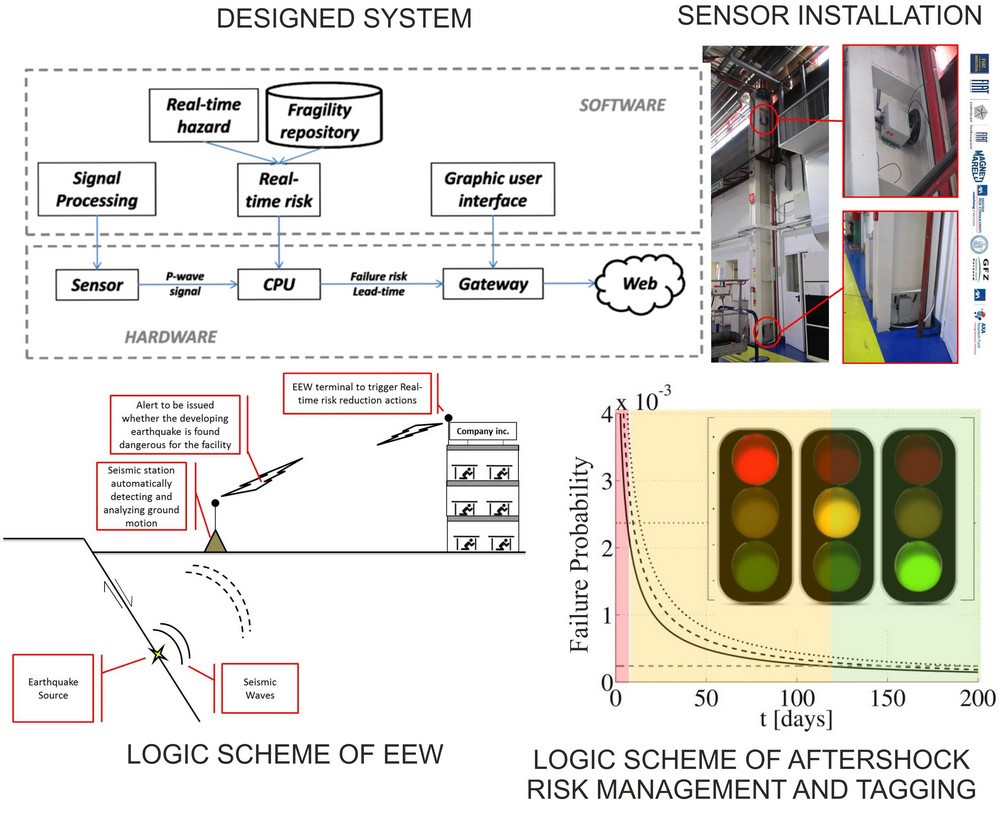
(i) The tool to manage seismic risk in real-time is earthquake early warning (EEW). The basic elements of an EEW system are: seismic instruments, a processing unit for the data measured by the sensors, and a transmission infrastructure spreading the alarm to the end users. This alarm may trigger security actions, manned or automated, expected to reduce the seismic risk in real time. The key design points for EEW applied to a specific structure are: (a) the estimated earthquake potential on the basis of the EEW information; (b) the available time before the earthquake strikes or lead time; and (c) the system performance (proxy for the loss) associated to the case the alarm is issued.
(ii) Major earthquakes (i.e., mainshocks) typically trigger a sequence of lower-magnitude events clustered both in time and space. Because the structural systems of interest might have suffered some damage in the mainshock, possibly worsen by damaging aftershocks, the failure risk may be large until the intensity of the sequence reduces or the structure is repaired. To evaluate this risk may be referred to as building tagging and allows to monitor the variation of structural risk due to both increased vulnerability, caused by cumulative damage, and time-decaying aftershock hazard, and to decide whether to prohibit access to anyone (i.e., red tag), allow access only to trained agents for emergency operations (i.e., yellow tag), or to resume from business interruptions allowing normal occupancy (i.e., green tag.)
(iii) Stochastic modeling of deteriorating structures at the scale of the life of the construction may include continuous degradation of structural characteristics and cumulative damage due to point overloads, such as earthquakes.
While (iii) is the subject of most of research and structural design procedures, topics (i) and (ii) are relatively unexplored, yet very relevant for industries, where downtime is the largest source of earthquake loss. Prof. Iunio Iervolino’s (from the reputed University of Naples Federico II, http://wpage.unina.it/iuniervo/) aims at assessing the benefits of earthquake early warning for factories. Prototypal implementation in the Magneti Marelli (FIAT Group) facility in Crevalcore (close to Bologna) should prove the efficiency of such warning systems before the ground motion hits the location— showing that action taken in a few tens of seconds may greatly limit the extent of non-structural and content loss, improving the resilience of the factory. Moreover, the project aims at investigating the feasibility of the use of the instrumentation for EEW, to also manage the aftershock risk of the facility in order to help the stakeholders and decision makers to tag the buildings and regulate occupancy during a seismic crisis.
Prof. Iervolino is well equipped to achieve his goals: he has teamed up with co-investigators with strong track records and works with partners in the prestigious German GeoForschungsZentrum, a world renowned center for hazard engineering with a broad range of international collaborations, including key links with Turkey and tsunami warning in the Indian Ocean. If the test site is successful, no doubt there will be followers!
To add or modify information on this page, please contact us at the following address: [email protected]
Iunio
IERVOLINO
Institution
AMRA
Country
Italy
Nationality
Italian
Publications associées
Natural Catastrophes
Volcanic Eruption
France
Prédire les risques volcaniques les plus imprévisibles
Lire la suite
Marina
ROSAS-CARBAJAL
Institut de Physique du Globe de Paris
Natural Catastrophes
Volcanic Eruption
United Kingdom
Dynamique du magma dans le volcan Erebus en Antarctique
Lire la suite

Tehnuka
ILANKO
University of Cambridge
Natural Catastrophes
Volcanic Eruption
Landslides & Mudflows
France
SEDIMER : risques et catastrophes liés aux sédiments par suite de l'éruption centennale du volcan Merapi (Indonésie) en 2010
Lire la suite
Franck
LAVIGNE